PVC vs SPC Solid Core Bathroom Panels: Which Suits Your Project?
Time to read 6 min
Time to read 6 min
Choosing bathroom panels usually starts with the colour or pattern. Once you begin comparing ranges, another question comes up: should you choose PVC or SPC solid core?
Both can create a practical, grout-free bathroom finish. The differences worth looking at are the construction, panel dimensions, surface finish and installation requirements.
Wide hollow-core PVC panels offer 1000mm-wide coverage per panel. Solid core panels offer a slimmer construction in various formats, with packs providing different coverage configurations for smaller and larger projects. Compare individual panel dimensions and total pack coverage alongside your wall layout.
The best choice depends on your bathroom and the result you want to create.
For this comparison, we are looking at our hollow-core PVC bathroom and shower panels alongside our 4mm solid core range.
The main distinction is the construction inside the panel.
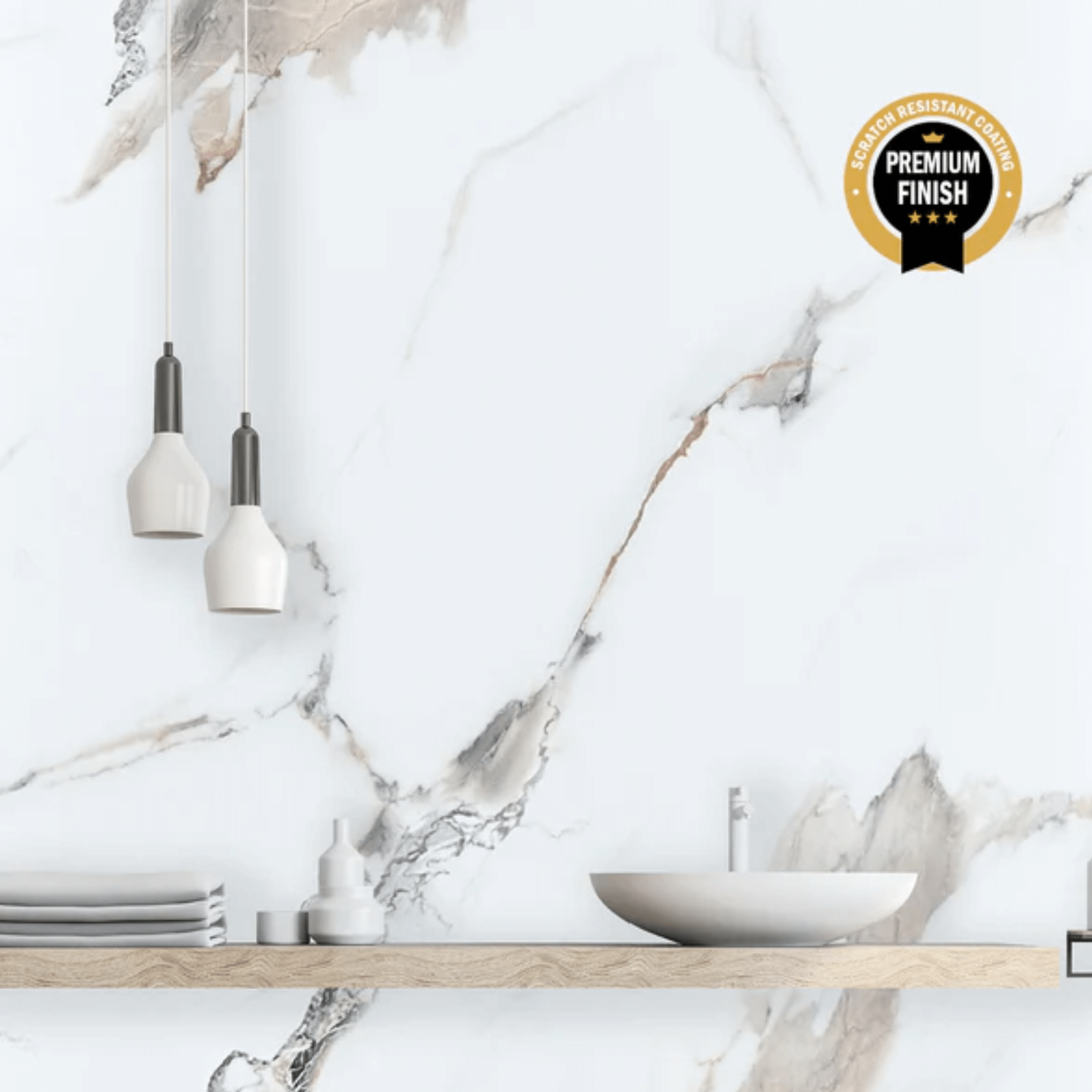
Hollow-core PVC panels have internal chambers supported by ribs. Our 10mm Pietra Marble Ultra Matt Shower Panel, for example, has this cellular structure.
Solid core panels have a continuous core instead of those hollow chambers. “Solid core” describes the construction, so it is useful to check the individual product specification alongside the range name.
This also explains why thickness alone is not a reliable way to judge a panel. A 4mm solid panel and a 10mm hollow panel are built differently.
Start with how the complete product suits your project: its format, finish, fitting requirements and the wall you want to cover.

The table below compares two examples from the Easy Panels ranges.
| Feature | 10mm Pietra Marble Ultra Matt PVC panel | 4mm White Marble Gloss Solid Core panels |
|---|---|---|
| Construction | Hollow cellular core | SPC Solid core |
| Panel thickness | 10mm | 4mm |
| Example dimensions | 1000 × 2400mm | 1200 × 2400mm or 900 × 1800mm |
| How these examples are sold | Individually | Packs of two large panels or four smaller panels |
| Surface finish | Ultra matt with a protective scratch-resistant film | Gloss decorative surface with UV coating |
| Joining system | Tongue and groove | Tongue and groove |
| Compatible trim range | 10mm trims | 4mm solid core trims |
These are product examples; specifications vary across the ranges. The solid core weight shown is a pack weight, while the PVC figure is for an individual panel.
Solid core panels come in various formats and are sold in packs, providing different coverage configurations for smaller and larger projects.
Pack of 1 — PVC: One 1000 × 2400mm panel covers 1000 × 2400mm.
Pack of 2 — SPC solid core: Two 600 × 2400mm panels placed side by side cover 1200 × 2400mm, with a join between them. This is wider than a single 1000 × 2400mm PVC panel.
Pack of 4 — solid core: Four 450 × 900mm panels arranged in two columns and two rows cover 900 × 1800mm. Other arrangements create different overall dimensions.
These examples show nominal coverage before cuts. Check usable coverage and fitting requirements for your chosen product.
Use the individual panel dimensions and total pack coverage to sketch your installation before deciding which format suits your walls.

Panel width affects how often a vertical joint appears.
A 1m-wide panel covers a wider section before another panel is needed than a 600mm-wide panel. Smaller rectangular formats introduce a different arrangement, including horizontal joins depending on the layout.
Neither arrangement has to look better. They create different effects.
For a broad shower wall, you may prefer larger panels that let the design occupy more uninterrupted space. For a smaller feature area, a compact format may suit the proportions and be easier to position.
Mark the panel boundaries on a simple drawing. Include windows, corners, boxed-in sections and the edges where the panelling will stop.
Also consider the pattern itself. A tongue-and-groove connection does not guarantee continuous marble veining. Check the pattern-matching information for the exact design before ordering.
The construction tells you what is inside the panel. The surface finish determines much of what you see every day.
Our bathroom and shower panel collection includes gloss, matt and ultra matt options, with designs ranging from marble and stone to tile effects and plain colours.
Think about the room you are creating.
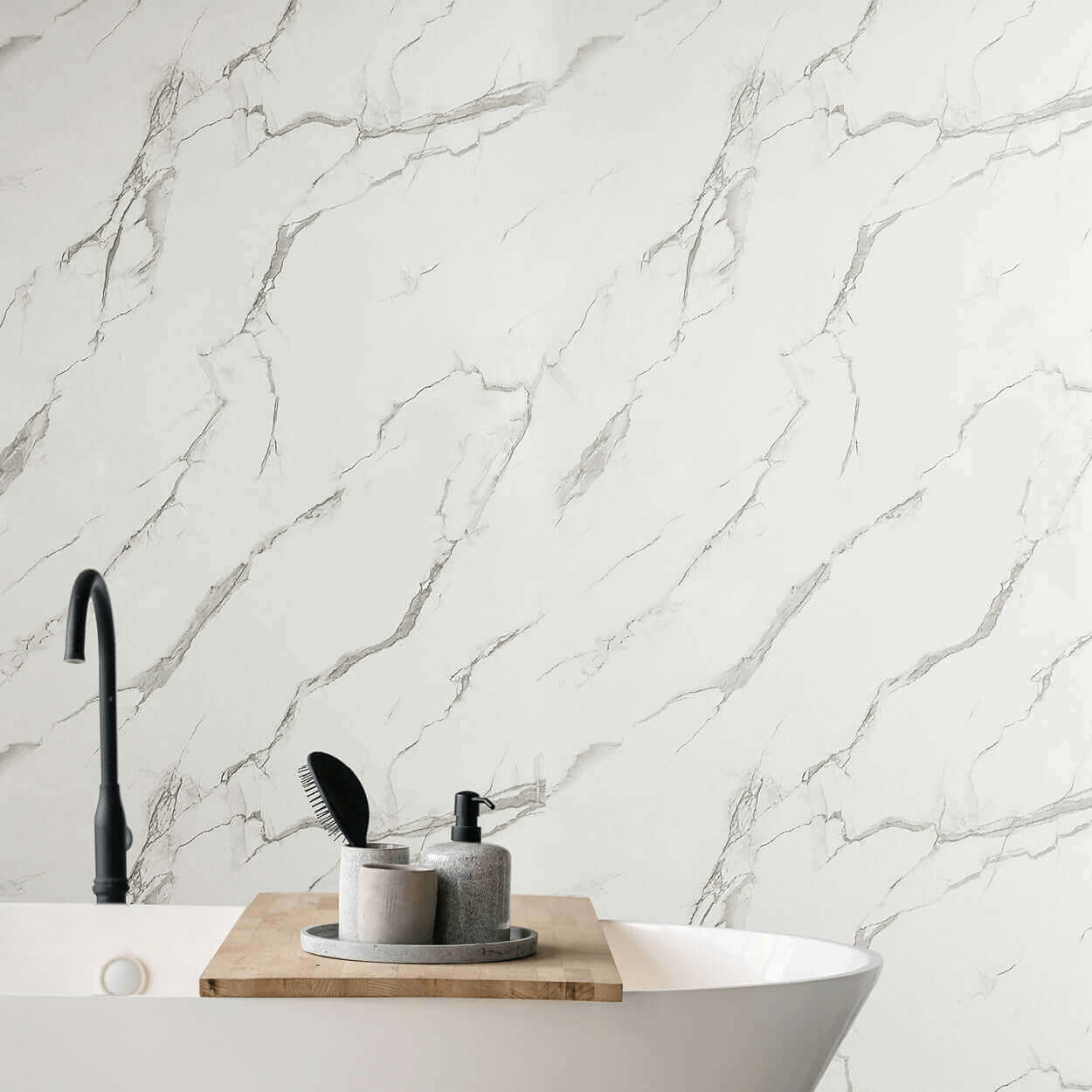
A glossy marble design can add reflection and a more polished appearance. A matt stone effect gives a softer backdrop beside timber furniture or textured accessories.
Surface protection is also product-specific. The protective coating on a premium PVC panel and the coating on a solid core panel should be assessed from their own specifications. A solid core does not automatically tell you how resistant its decorative surface is to scratches.
Compare samples beside the flooring, vanity and fittings that will remain. Look at the finish in daylight and under your bathroom lights.

Panel dimensions matter when you are carrying materials upstairs, turning through a doorway or working in a compact bathroom.
A full-height panel needs space to manoeuvre and support during cutting. Smaller panels may be easier to position individually, although there will be more separate pieces to fit.
Check both the weight and the dimensions. A slimmer panel is not necessarily lighter.
Our White Marble Gloss solid core specifications list a knife or saw as suitable cutting methods. Follow the product’s fitting guide for the correct technique and tools, particularly around joints and detailed cut-outs.
For either range, read the installation instructions before committing to DIY. Consider the most difficult part of your room: a window reveal, several pipe openings or a narrow section behind a fitting.
That detail may have more influence on the job than the size of the main wall.
Both ranges need a suitable installation surface and correctly finished connections.
Check the wall condition before ordering. Existing damage, leaks or unsuitable surfaces need addressing as part of the preparation.
Use the accessories specified for your chosen system. Our 10mm PVC panels and 4mm solid core panels use different compatible trim ranges, so trims should be selected alongside the panels.
In shower areas, follow the guidance for sealing joints, corners, edges and openings. Waterproof panels still depend on correct fitting to form a watertight installation.
Include these requirements in your discussion with an installer. Ask them to check the complete layout and shopping list, including adhesive, sealant and trims.
Our how-to guides can help you understand the preparation and fitting involved.
A price per panel and a price per pack cannot be compared directly.
First, work out how many panels or packs your wall layout requires. Include cuts and any extra material needed to complete awkward sections.
Then add the compatible trims, fitting materials, delivery and installation costs.
A smaller format might make good use of material in one bathroom but create extra cuts in another. A wide panel may simplify a shower wall while leaving an offcut that cannot be used elsewhere.
Compare two complete shopping lists for the same area. That gives you a more useful decision than choosing the lowest displayed price.
Start by comparing the wide PVC shower panels.
Their format may suit your layout if you want fewer vertical connections across a large section. Check the usable dimensions, pattern and access into the room before deciding.
Explore the different solid core formats and pack sizes.
These can suit smaller feature areas or larger projects, depending on how the panels are arranged. Sketch the complete pack layout, including joints and cuts, to see which configuration makes the best use of your space.
Compare the 4mm solid core range.
Include adhesive and preparation in your planning: the panel thickness is only one part of the finished build-up against the existing wall.
Let your shortlist guide the comparison.
You may find that the design you prefer is the deciding factor once both options meet the practical requirements of the room.
Check these five points against your shortlist:
Layout: Which panel size fits your walls with sensible cuts?
Appearance: Do you like the finish, pattern and expected joint arrangement?
Handling: Can the panels be moved and worked on comfortably in your space?
Installation: Have you included the right preparation, trims and fitting materials?
Budget: What does the complete project cost with each option?
Explore our Bathroom Wall & Shower Panels collection and 4mm Solid Core range to compare the options.
Once you have a shortlist, order samples to see the colours and surfaces in your bathroom before making the final choice.