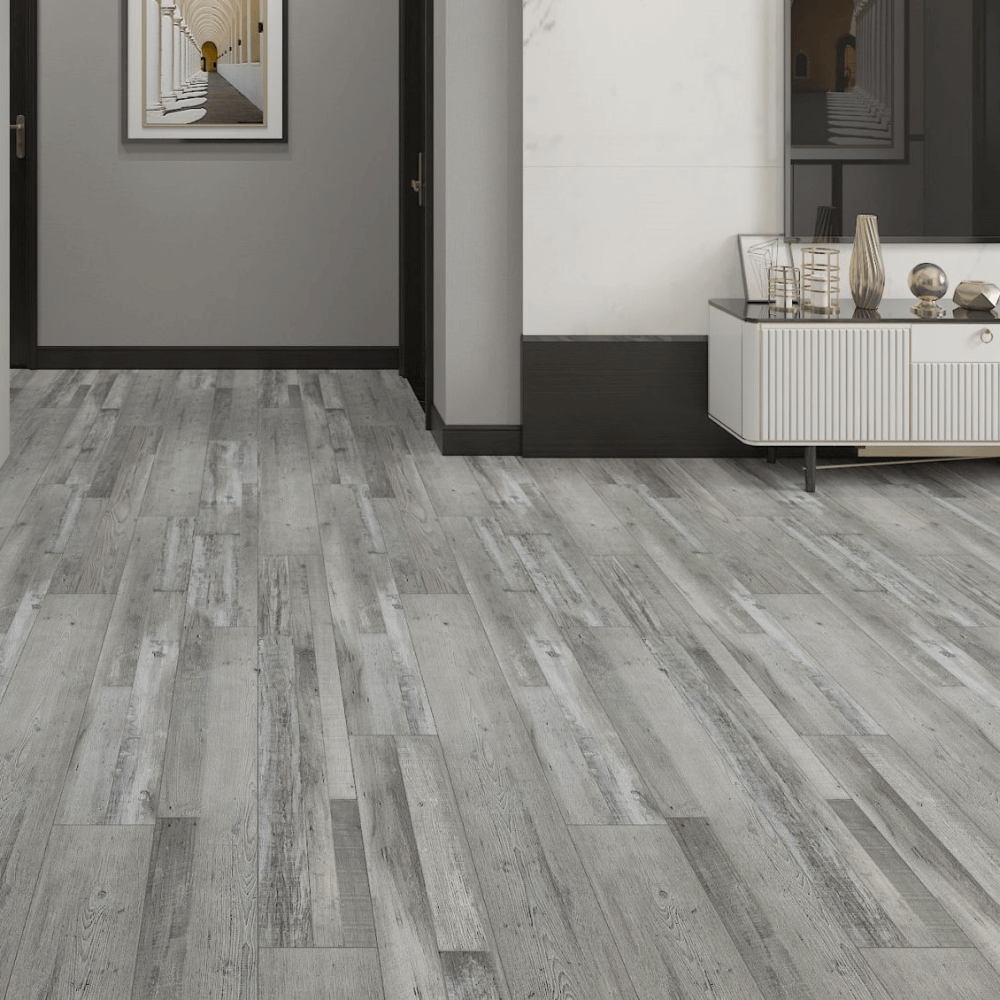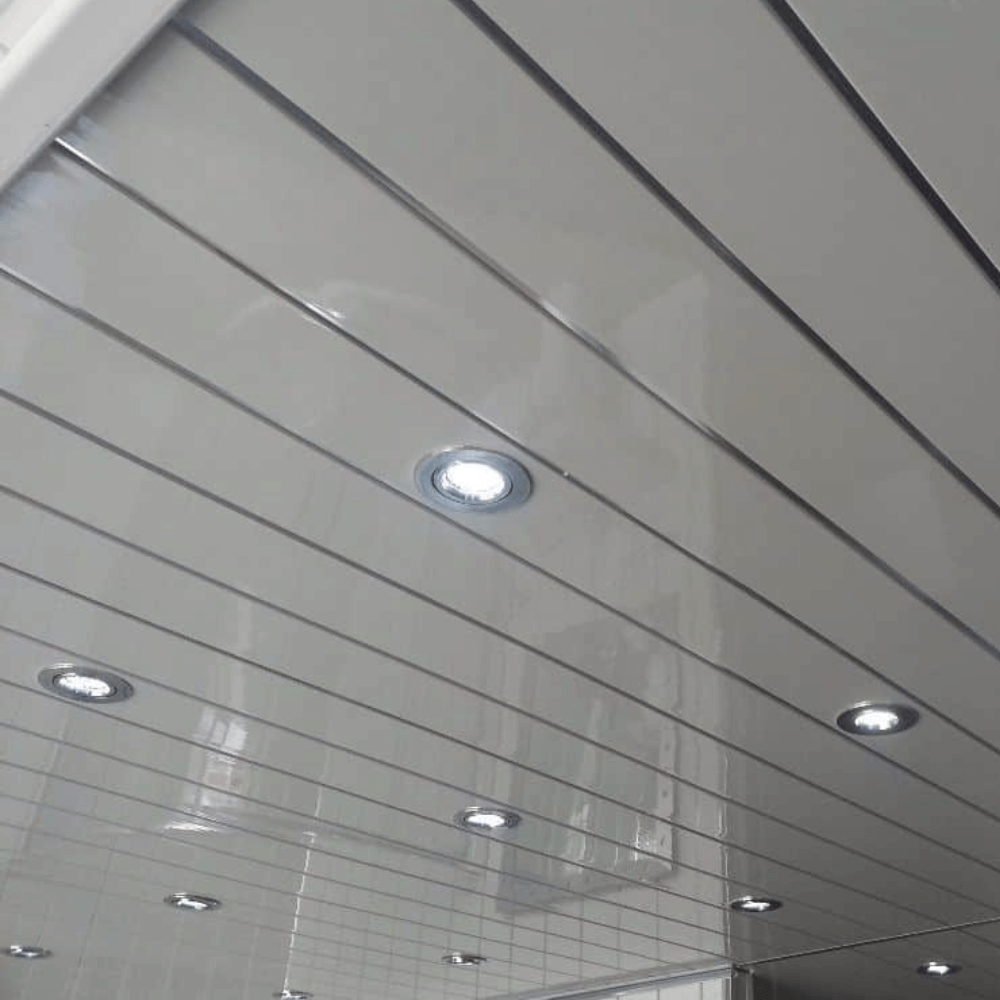
Your bathroom wall panel samples have arrived. On the kitchen table, one immediately catches your eye. But will it still be your favourite beside the bathroom floor, under the evening lights or next to the vanity?
Samples are most useful when you compare them in the space where the panels will be fitted.
Hold them upright, check them beside the finishes you are keeping and look at them at different times of day. Then use full-panel photographs to understand the pattern beyond the small piece in your hand.
Here is a simple way to turn your shortlist into a confident choice.

1. Give each sample a clear identity
Before comparing colours, make sure you know exactly which product each sample represents.
Keep the product name, finish and range with it. If you add your own label, place it on the back so it does not cover the surface you are assessing.
This is particularly helpful when comparing similar marble, stone or grey designs. Two samples may look close in colour while belonging to different panel formats or constructions.
Save the matching product pages too. You will need those later to check dimensions, full-panel images and fitting requirements.
2. Hold samples upright in the intended position
A sample lying flat on a table catches light differently from a panel fitted vertically to a wall.
Take it into the bathroom and hold it upright where you plan to install the panels.
Start with the main area, such as the shower wall or the space behind the bath. Then try it on any other walls you intend to cover.
Notice how it looks in the brighter and more shaded parts of the room.
If your existing wall colour is strong, it may influence your impression of the sample. Try placing a larger piece of plain white card behind the sample to get a more authentic impression of the panel's pattern and colour.
Finally, step back. Look from the doorway as well as close up. You are choosing a finish for the room, so both views matter.
3. Compare it beside the finishes that are staying
The best-looking sample on its own may not be the best fit for your bathroom.
Place each one beside the floor, vanity and sanitaryware you are keeping. Check these combinations separately before looking at the room as a whole.
Beside the floor
Hold the sample vertically near the point where the wall meets the floor.
Does the combination feel balanced? Do the colours share similar undertones, or do you like the contrast between them?
If the floor has a busy pattern, consider whether the panel introduces another strong design or provides a quieter backdrop.

Beside the vanity
Look at the sample against the furniture colour, including any timber tones.
A grey panel may appear cooler beside golden oak. A beige panel may look warmer beside a white vanity.
These differences can be useful. The question is whether you like the combination.

Beside the bath and basin
Compare pale samples directly with the white sanitaryware.
You may find that one looks creamy, another slightly grey and another much brighter. Decide whether you prefer a close colour relationship or a more noticeable contrast.
Include fittings and visible trim colours in your comparison where possible. They will form part of the finished scheme too.

4. Check daylight and evening lighting
Leave the decision open until you have seen the samples under the lighting you normally use.
Try them during the day, then again with the bathroom lights switched on in the evening. If the room has no window, compare them under its usual artificial lighting.
Pay attention to what changes.
Does your favourite grey begin to look blue? Does a warm neutral become more yellow than you expected? Does a darker design still give you the atmosphere you want?
Use the same position for each sample so the comparison is fair.
Photographs can help you remember the combinations, but your phone may adjust brightness and colour automatically. Make the final colour decision by looking at the physical samples in the room.
5. Compare the surface finish as well as the colour
Two panels with similar colours can create a different impression because of their finish.
Tilt each sample slightly and watch how it catches the light.
A gloss surface produces more distinct reflections. A matt surface gives a softer reflected effect. Look at both straight on and from an angle, especially if the bathroom has a window or a strong light beside the proposed panelled wall.
Run your fingers gently across the surface too.
Check whether the texture matches what you expected from the photograph. A design that looks like stone or tiles may have a smooth decorative surface rather than the physical texture of those materials.

6. Look beyond the sample for the full pattern
A sample shows a small section of a much larger design.
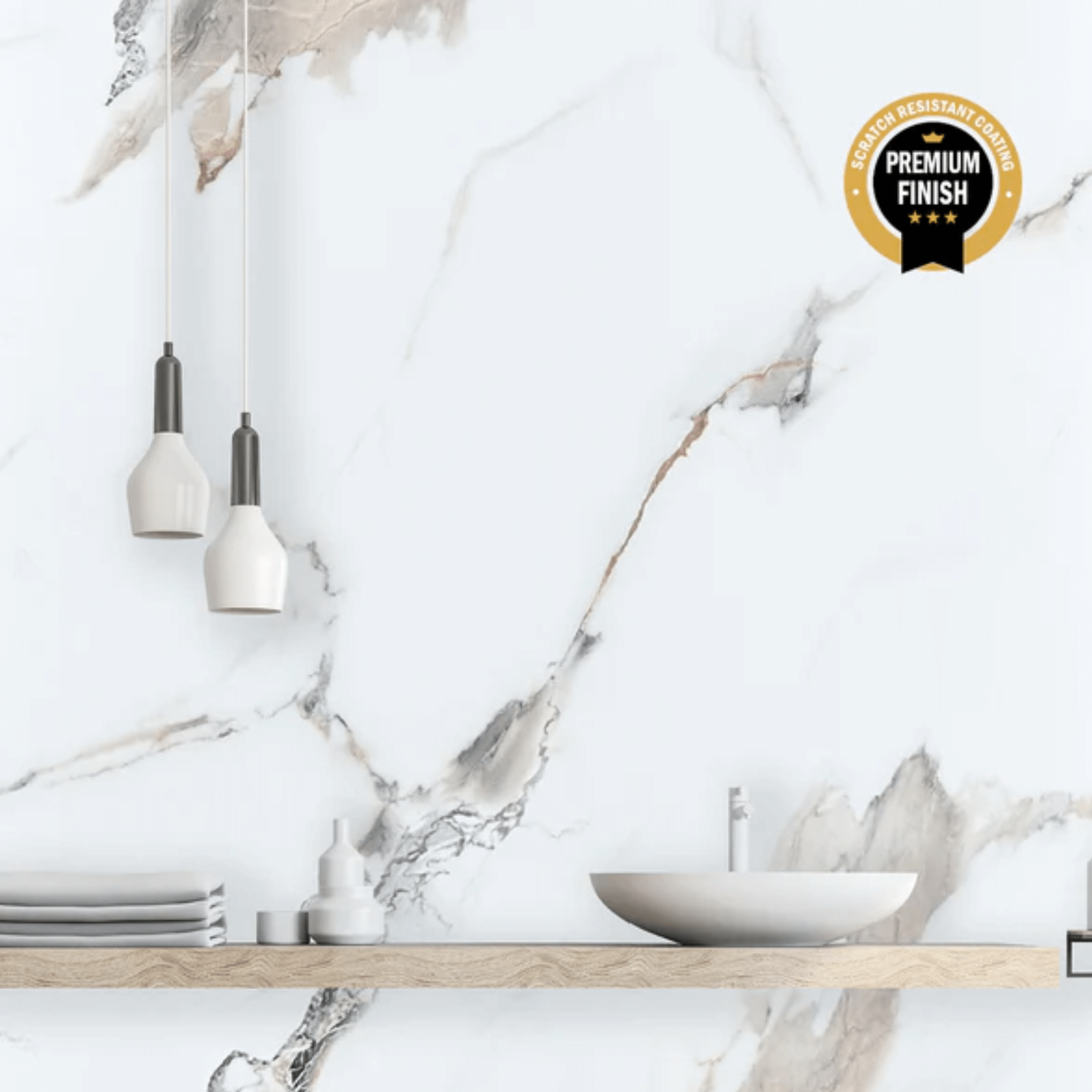
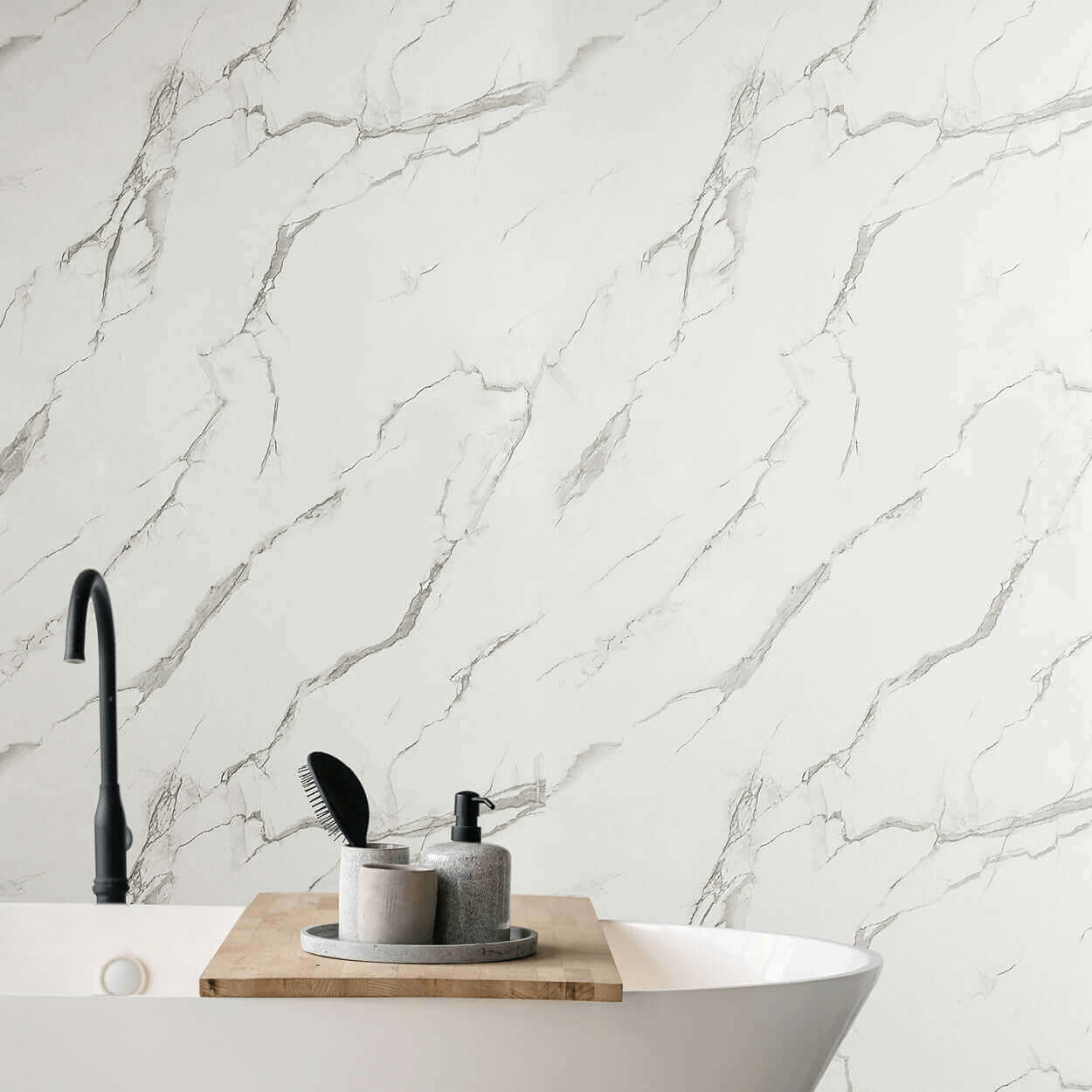
That matters particularly with marble veining, broad stone markings and tile effects. Your sample may contain a quiet part of the pattern while the full panel includes a much stronger feature.
Open the product’s full-panel image alongside the sample.
Look for:
The size and direction of the main markings.
Areas of stronger contrast.
How much plain background surrounds the pattern.
Any decorative tile lines or repeated shapes.
How the design looks across several installed panels.
Imagine those features at the actual panel size.
A bold vein that looks attractive in a small photograph may become a prominent part of the wall. Equally, a subtle sample may belong to a design with more movement than you realised.
Use the physical sample for colour and surface assessment, and the larger images for pattern and scale.
7. Understand what a sample cannot tell you
Samples are one part of choosing bathroom panels. They cannot answer every question about the completed installation.
| A sample helps you assess | Check elsewhere |
|---|---|
| Colour beside your floor and furniture | Full-panel dimensions and usable coverage |
| Gloss, matt appearance and surface feel | The complete pattern and its repeat |
| How the finish looks in your lighting | Whether patterns match across adjacent panels |
| Your preference between shortlisted designs | The appearance of installed joints and corners |
| The construction visible in that sample | Required trims, adhesive and fitting method |
A small sample also cannot show how manageable a full-size panel will be when carried, cut or positioned.
Before ordering, review the product information and installation guidance. If a particular detail will affect your choice, ask the Easy Panels team to clarify it.

8. Compare the shortlist, then view your favourite alone
Putting samples side by side is useful for spotting differences.
Once you have narrowed the options, remove the others and spend some time looking at your favourite on its own.
This helps you judge how it works with the bathroom rather than how it compares with another sample. A shade that seems warm beside a cool grey may feel quite balanced when viewed independently.
Repeat the same checks with your second choice if you are undecided.
Keep the decision focused on the room: the floor, furniture, lighting and the amount of wall you want to cover.
Your bathroom panel sample checklist
Before choosing, ask yourself:
Do I like the colour beside the existing floor and vanity?
Does it work with the bath, basin and fittings?
Am I happy with it in daylight and evening lighting?
Do I like the surface finish and feel?
Have I checked the full pattern at panel scale?
Do I understand the expected joints and pattern matching?
Have I checked the dimensions and installation requirements?
If two samples still feel equally suitable, compare their full wall layouts and complete project costs. The panel format or cutting requirements may make one a more practical choice.
See your shortlist in your own space
The aim is to choose a panel you enjoy looking at in the bathroom you actually have.
Give the samples a little time, compare them in consistent positions and check the larger design before ordering. Those simple steps can make the final decision much clearer.
Explore our Bathroom Wall & Shower Panels collection, then order samples to see your shortlist at home.