Do Shower Panel Joints Show? What to Expect from Seams, Corners and Patterns
Time to read 6 min
Time to read 6 min
Shower panels can create a clean, continuous look across a bathroom wall. But if you are imagining the finished room, you may be wondering whether you will see where one panel meets the next.
Yes, shower panel joints can be visible. How noticeable they are depends on the joint system, panel design, lighting and installation.
A neatly fitted joint may be subtle, particularly when viewed from across the room. Up close, you may still see a fine line or a change in the pattern.
Understanding those details before ordering helps you choose a finish you will be happy with across the whole wall.
A panel-to-panel joint is the point where two separate panels meet on the same wall.
Many of our shower panels use a tongue-and-groove system. One panel edge slots into the next, creating a close-fitting connection. For example, our 10mm Pietra Marble Ultra Matt Shower Panel uses this type of joint.
The appearance of that connection is separate from the pattern printed on the surface.
You might notice a narrow joint line, a change in the decorative design, or both. A close-fitting joint does not automatically mean the pattern continues uninterrupted.
When comparing panels, look at photographs showing several installed side by side. A single-panel image can show the design clearly, but it cannot demonstrate how the joins will look across a wider wall.
Shower panels are often described as creating a seamless or grout-free finish.
Grout-free means the installation does not have the grouted joints associated with traditional tiling. It does not guarantee that every connection between panels will disappear.
There are still separate panels, corners and edges to consider.
The useful question is how those details will look together in your bathroom. A subtle vertical joint may barely attract attention within the overall scheme, even if you can find it when looking closely.
Think about the wall from your usual viewing positions: the doorway, the basin and inside the shower. Those views give you a more practical sense of the finished result than a close-up alone.
This is one of the most useful things to check before choosing a marble-effect panel.
A repeating design and a matching design are different things.
A pattern repeat means decorative features recur across the panels. Pattern matching means the design is specifically arranged to continue from one panel into the next.
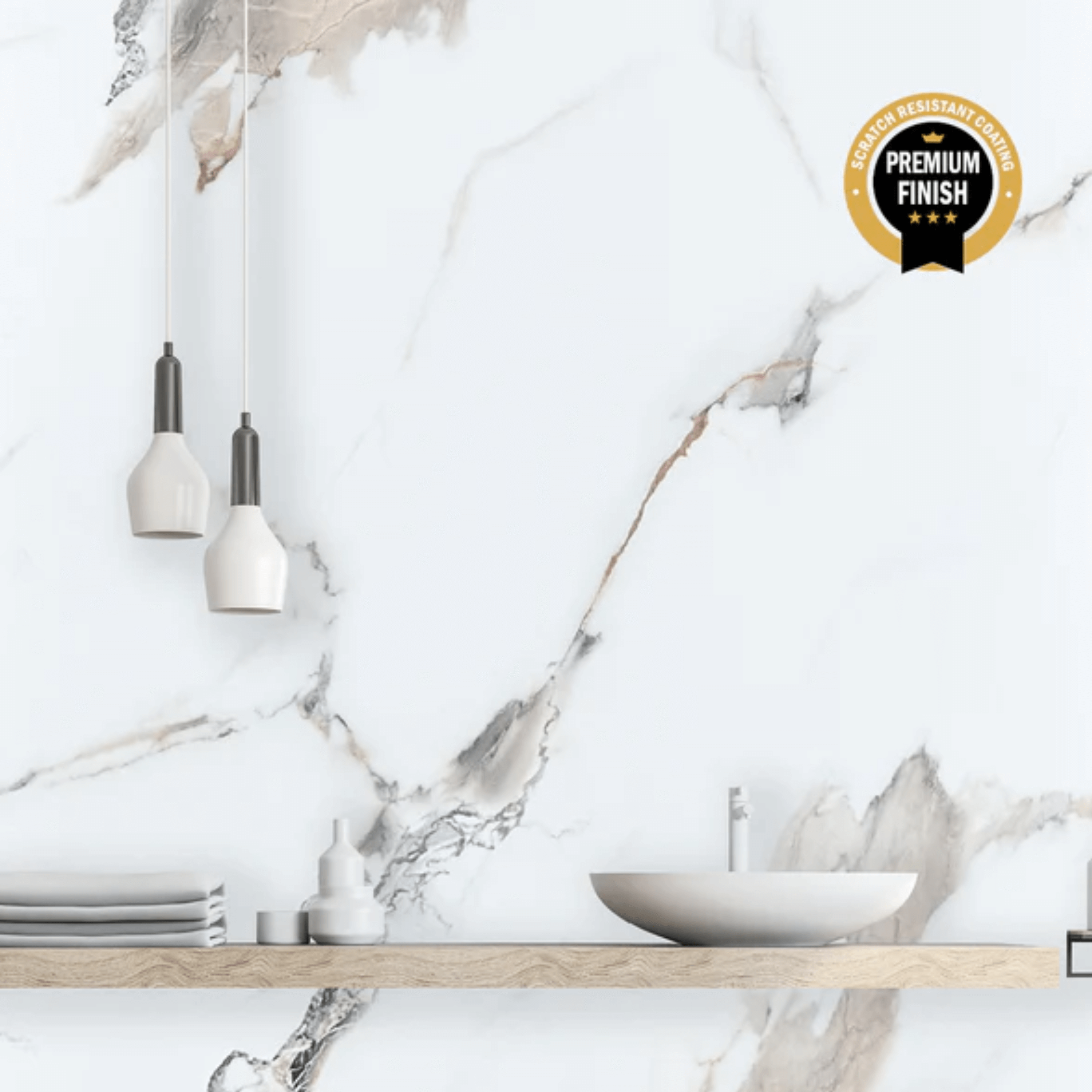
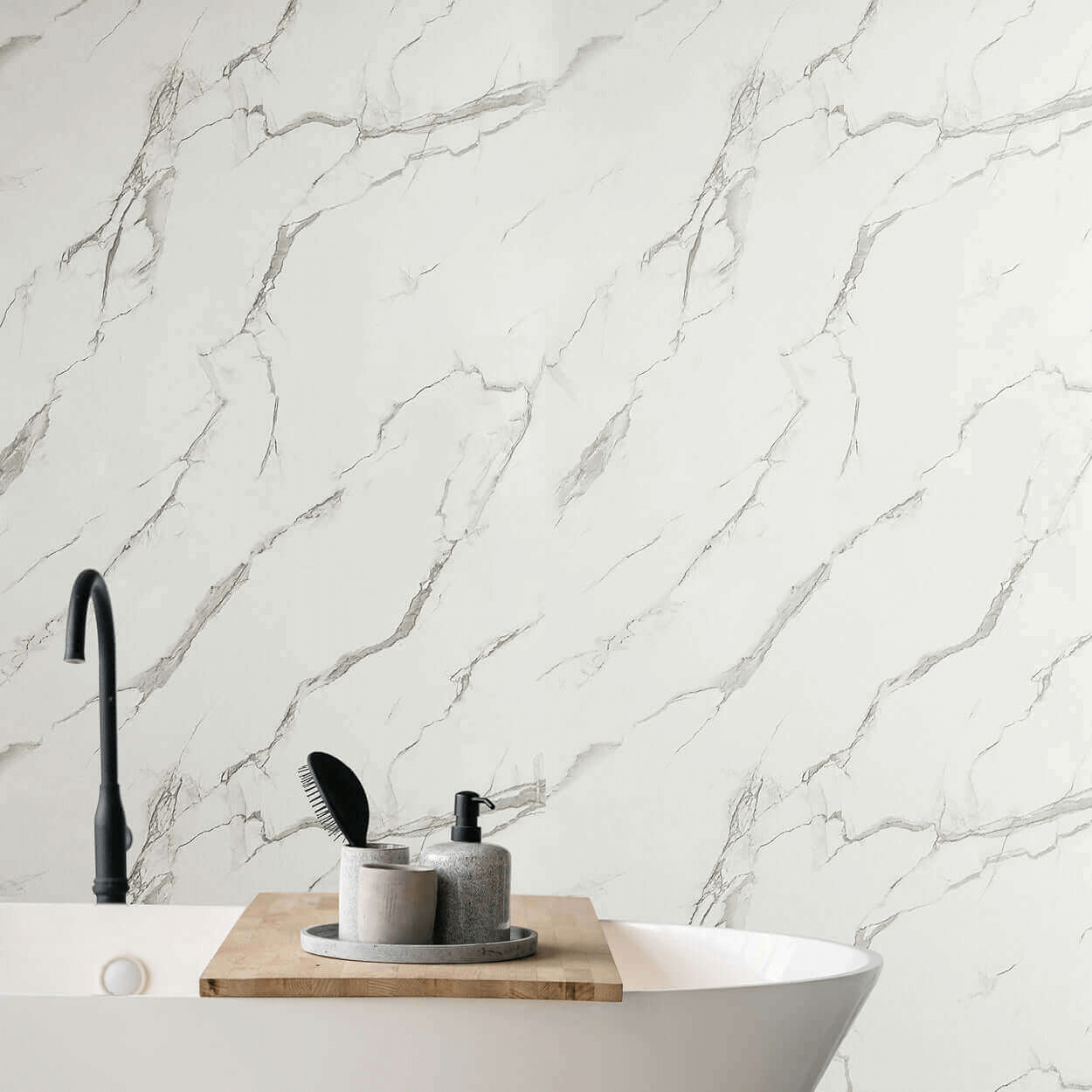
Our marble-effect panel descriptions explain that the veins do not seamlessly match across multiple panels. For example, this applies to the 10mm Pietra Marble Ultra Matt Shower Panel and 10mm Oro Gold Marble Ultra Matt Shower Panel.
That means a vein reaching the edge of one panel may not continue at the same position on the next.
You can still create a coordinated marble scheme, but you should expect changes in the veining at panel boundaries.
Look at the full design before deciding. If your favourite feature is a large, sweeping vein, consider how you will feel about that line stopping or changing direction where the panels meet.

Different designs draw attention to different parts of the wall.
A plain panel keeps the overall scheme simple, with no decorative pattern to align.
However, an uninterrupted colour also gives the eye fewer other details to focus on. A fine joint line or shadow may be easier to spot in certain lighting.
Choose a plain finish because you like its clean appearance, while allowing for the connections between panels.
Gentle tonal variation can make a wall feel visually consistent without relying on individual veins lining up.
These designs are worth comparing if you prefer a quieter backdrop. You may still see the joints, but the overall effect does not depend on one strong pattern continuing across them.
Large veins and stronger colour changes bring more movement to the room.
They also make it more important to understand what happens at each panel edge. Review images of the design across a larger area, particularly if you are covering several walls.
Tile-effect designs introduce decorative lines as part of the surface pattern.
For example, our 10mm London Tile Gloss Shower Panel has a flat-printed metro tile design. Those printed lines are different from the physical joints between panels.
Before ordering, check how the design meets at the panel edges and how cuts will affect the layout. A tile effect does not automatically mean every panel joint will sit within a printed tile line.
A straight join between two panels is only one part of the installation.
You also need to consider where walls change direction and where the panelling stops.
| Detail | Where you will see it |
|---|---|
| Panel-to-panel joint | Between adjacent panels on the same wall |
| Internal corner | Where two walls meet in an inward corner |
| External corner | Around an outward corner, such as some boxed-in sections |
| Exposed edge | Where the panelling finishes beside another surface |
Compatible trims finish these transitions. The profile needs to suit the panel system: our 4mm solid core panels, for example, have their own compatible 4mm trim range.
Treat trim colour as part of the design.
A similar colour can help the edge blend into the scheme. A contrasting trim creates a more defined border and may work well alongside matching fittings.
Our guide to panel trims explains the different profiles and where they are used.
The number and position of joints depend on the panel format and the wall layout.
A wider panel can cover more of a wall before another vertical connection is needed. Smaller formats create a different arrangement, potentially including both vertical and horizontal joints.
For example, our solid core range includes 2400mm × 600mm panels as well as smaller formats. Those dimensions create different layout options, even when the chosen colour is similar.
Before ordering, sketch each wall and mark where the panels will sit.
Consider the view from the doorway, the position of the shower fittings and any narrow sections beside windows or corners. Check usable panel coverage and installation requirements when calculating the layout.
This helps you understand the finished appearance before anything is cut.
A joint can look different depending on where the light falls.
Light travelling across the surface may make a small change in level or a joint line more noticeable. Reflections can also draw attention to surface details, particularly on glossy finishes.
That does not make one finish universally better than another. It means the room’s lighting is part of the result.
Careful preparation and fitting matter too. Follow the instructions for the chosen panel system, including the requirements for the wall surface, joints, trims and sealing.
A visible fine line alone does not tell you whether an installation is watertight. Equally, a joint that looks discreet is not proof that it has been sealed correctly.
If a finished joint has an unexpected opening, uneven edge or movement, ask the installer or Easy Panels team to assess it against the product guidance.
If joint appearance is a deciding factor, ask these questions while comparing your shortlist:
What type of joint does this panel use?
Can I see a close-up photograph of two installed panels meeting?
Does the pattern match across adjacent panels?
Which trims are required for corners and exposed edges?
Where will the joints fall in my bathroom layout?
How will cuts around windows and fittings affect the design?
Samples are useful for assessing colour and surface finish. A small sample on its own will not show a full installed joint or how a large pattern repeats across the wall.
Combine samples with full-panel images, genuine installation photographs and the guidance for your chosen product.
The finish you choose needs to work across the complete installation: panels, joins, corners and edges.
Soft patterns can create a calm backdrop. Bold marble can make the walls a feature. Tile effects bring a more structured design. Each can work well when you understand how the separate panels come together.
Explore our Bathroom Wall & Shower Panels collection to compare designs, or speak to the Easy Panels team if you would like help checking the joint and trim details before ordering.